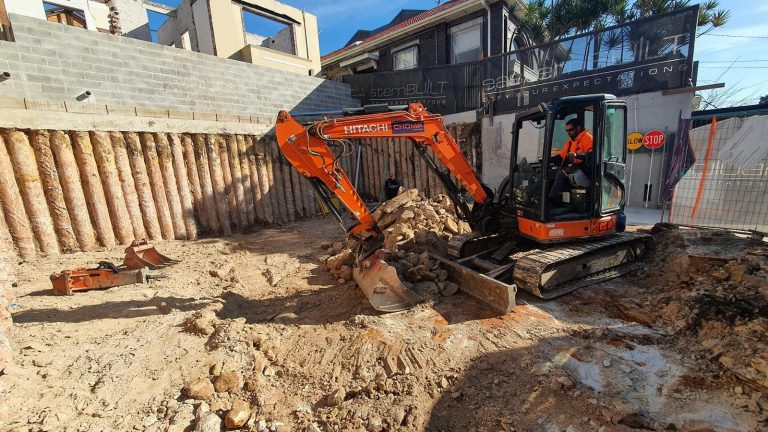
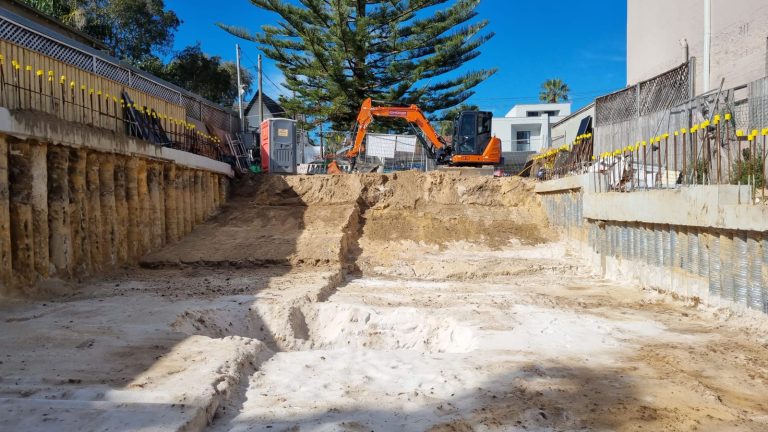
Tight Access Excavation: When a Machine Won’t Fit
How tight access excavation works in Sydney: minimum machine widths, hand digging, shoring past 1.5 metres and how spoil leaves a site with no stockpile room.
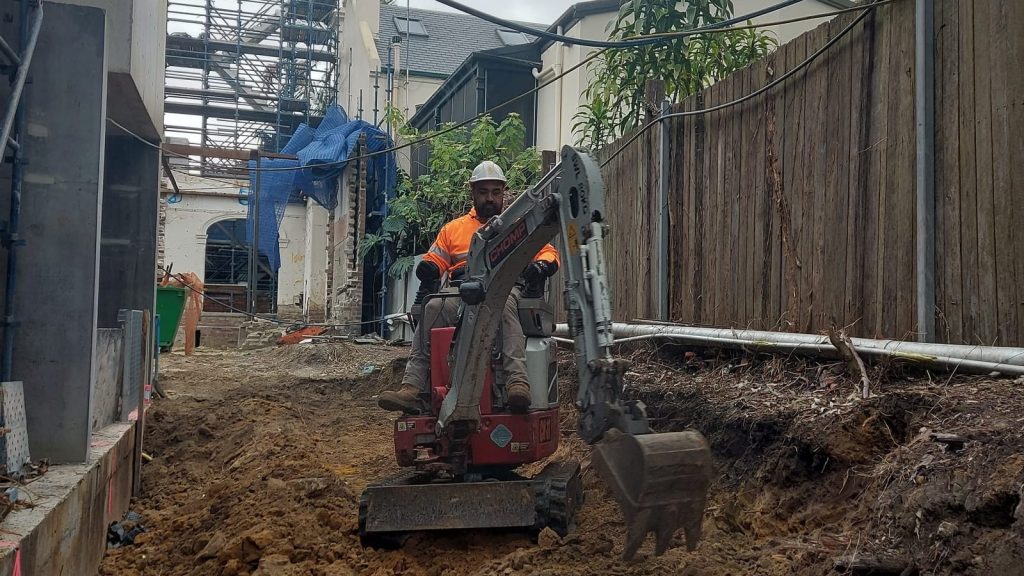
A 1.7 tonne excavator typically needs around 1.5 metres of clear width to track through. Some small tracked machines will work in roughly 750 to 900 millimetres, but they are slower and shallower. If your only access is a 900 millimetre side path, the dig is usually still possible, but the method and the program change.
This is written for the builder or architect facing a site that two contractors have already walked away from. The job is usually doable. It just has to be planned differently.
At a glance
- 1.7 to 3 tonne excavator: around 1.5 metres of clear width
- Some small tracked machines: roughly 750 to 900 mm, slow and shallow
- Excavation past 1.5 metres needs shoring, benching or battering in NSW
- On tight sites you usually shore rather than batter, because there is no room for a slope
- Spoil has to leave as it is dug, because there is nowhere to stockpile
- Hand digging is sometimes cheaper than a machine that cannot turn
What actually counts as tight access?
More situations than people expect:
- Side access under 1.5 metres
- Rear lane access with a step, slope or cross-fall
- No off-street parking, so spoil must cross a footpath
- Overhead structures such as a carport, balcony or awning
- Basement or under-house work where the machine lowers as it digs
- Steep blocks where a level working platform cannot be established
How do you excavate a site a machine cannot reach?
Four approaches, in escalating complexity.
Smaller machine. A 1 to 1.7 tonne excavator fits where a 3 tonne will not. The trade-off is speed, because fewer cubic metres move per hour, so the effective rate per metre rises.
Remote or specialised plant. Some machines operate remotely where an operator cannot stand safely, which matters under existing structures.
Conveyor or purpose-built spoil system. Where a wheelbarrow run would be 30 metres, a conveyor moves material far faster. On some sites a purpose-built extraction system does the same job.
Hand digging. Slow and labour heavy per cubic metre, but sometimes the only option, and occasionally the cheapest overall when the alternative is a week of mobilisation for a machine that cannot get out again.
The decision comes down to volume. Ten cubic metres by hand is a hard day. A hundred cubic metres by hand is a different project.
What does depth add to a tight access job?
Once you pass 1.5 metres, the excavation becomes high-risk construction work and the faces must be protected by shoring, benching or battering. On a restricted site you usually cannot batter, because the slope needs room you do not have. So you shore.
Shoring on a tight site is harder than on an open one because it has to be installed by hand or with small plant. That is why basement work in restricted conditions is specialist work rather than a bigger version of a normal dig. If the job is a basement under a standing house, our piece on whether a site can take a basement covers the underpinning sequence.
Where does the spoil go?
This is the constraint that catches people out. A tight site usually has nowhere to stockpile, so material leaves as it is dug. That means trucks on rotation, someone managing the street, and often a footpath crossing or traffic control.
On sites with heritage or parking restrictions, the binding constraint is frequently the hours you are permitted to load out rather than the digging itself. Establish that before mobilisation, not on day one.
Frequently asked questions
How narrow can a machine get?
Some small tracked excavators work in roughly 750 to 900 mm of clear width, but they are limited in reach and depth. Below that it becomes hand work or remote plant.
Can you work around a pool or granny flat in the backyard?
Usually, if there is a route in. If the only access is through the house, that changes everything and gets discussed before we price it.
What if there is rock?
Rock in tight access is the hardest combination. Sandstone needs a rock hammer or saw and comes out far fewer cubic metres an hour. Our rock excavation page covers that separately.
What equipment do you use on restricted sites?
It varies by job. Our excavation equipment page sets out the machine range and what each is suited to.
Working a restricted site? Contact us. Restricted access work is a large part of what we do, including tight access detailed demolition and hand demolition. Send the plans and we will tell you honestly whether it is a machine job, a hand job, or not viable.